
Table of Contents
Executive Summary…..2
History…..2
Mission Statement…..3
Child Welfare Ombudsman Overview…..4
Best Practices, Growth, Training, and Outreach…..4
Program Policy and Procedure Development…..5
Contact Data and Statistics…..6
Numbers and Types of Contacts…..6
Type of Requests…..7
Requests by County…..8
Trends…..9
Juvenile Justice…..11
Success Stories…..13
Barriers to Investigations…..14
Recommendations…..15
Legislative…..15
General……15
Summary…..16
Glossary of Acronyms…..18
Appendix…..19
Enabling legislation
Executive Summary
Welcome to the 2023 report of the Office of the Child Welfare Ombudsman (CWO), a program created by the Arkansas General Assembly to provide for independent oversight of the child welfare system in Arkansas. This annual report is mandated by the enabling legislation, Act 945 of 2019 sponsored by Senator Alan Clark. The reporting period includes activities of the CWO office for the calendar year 2023.
History
The Child Welfare Ombudsman Division was created by the 92nd General Assembly and housed within the Arkansas Commission on Child Abuse, Rape and Domestic Violence (ACCARDV); an agency with more than two decades of child welfare experience, while being uninvolved in the investigative, administrative or judicial handling of child maltreatment cases. This allows the CWO to function independently of the Department of Human Services, Administrative Office of the Courts, Commission for Parent Counsel, Attorney Ad Litem Program, Arkansas Public Defender Commission and Arkansas Court Appointed Special Advocates as mandated by A.C.A. 20-82-211(a)(5)(A).
The Arkansas Commission on Child Abuse, Rape, and Domestic Violence (ACCARDV) was established in 1991 to enhance the coordinated approach in providing services to victims of child abuse, rape, and domestic violence.
Today the mission of ACCARDV is to enhance investigation, prosecution, treatment, support, and prevention in cases of child abuse, rape, human trafficking, and domestic violence. ACCARDV fulfills this mission through a collective impact approach consisting of two arms that work together to enhance victim services around the state. There are 22 Commissioners appointed by the Governor who serve as an advisory council and representatives of their communities and interests surrounding violence and abuse. The Commissioners work in the areas of focus or have experience with one or more of the issues. They convene triannually to discuss the Commission goals, projects, and strategies to help the people of Arkansas.
ACCARDV staff carry out the projects of the Commission by leading work groups, obtaining and administering funding, analyzing gaps and barriers, advocating for individuals, identifying needed access, looking for policy and funding solutions, and bringing together advocates and service providers to develop solutions. ACCARDV staff members work closely with other state level service-providers and collaborate with Commissioners to ensure that all areas of the continuum are being met across each of the Commission’s focus areas. ACCARDV is housed within the University of Arkansas for Medical Sciences (UAMS) which allows for integration and the support of other departments and colleges.
The first Child Welfare Ombudsman was hired by the Executive Director of ACCARDV in December of 2020, and the office officially opened on January 11, 2021. In September of 2022, the Ombudsman moved into the position of the Executive Director of ACCARDV and hired a new Child Welfare Ombudsman.
Mission Statement
The mission of the Child Welfare Ombudsman office is to review an issue or complaint in any child welfare case or investigation in which a child or their family needs assistance from the Ombudsman; to bring resolution when possible; and to advocate for policies and procedures that will improve the child welfare system in Arkansas.
Child Welfare Ombudsman Overview
Best Practices and Growth: Information was gathered from other states on Child Welfare Ombudsman practices, procedures, and data collection. Complaint forms and brochures were developed and disseminated through the ACCARDV website, mailouts, and handouts at conferences and meetings. Guidelines and best practices were gained from the United States Ombudsman Association (USOA) https://www.usombudsman.org and set forth as the best practices for the Child Welfare Ombudsman Office. Those guidelines are:
- Independent. An Ombudsman office should be free from outside control or influence.
- Impartial. An Ombudsman should receive and review each complaint in an objective and fair manner, free from bias, and treat all parties without favor or prejudice.
- Confidentiality. The Ombudsman should have the privilege and discretion to keep confidential or release any deindentified information related to a complaint or investigation.
- Credible Review Process. The Ombudsman should perform his or her responsibilities in a manner that engenders respect and confidence and be accessible to all complainants.
Training: The USOA provides training for new Ombudsmen each year. In 2023, Stasia McDonald and Zachary Barnes attended the USOA conference held in Atlanta, GA, including a New Ombudsman training which was held in person for two days prior to the regular conference.
Current issues in Arkansas child welfare are ascertained by attending Children in the Courts. National child welfare issues are monitored through organizations such as National Association of Counsel for Children, OJJDP, Annie E. Casey Foundation, and the American Bar Association.
Outreach: The Ombudsman reached out to stakeholders within the Child Welfare Community throughout the year through virtual meetings of the Commission, providing brochures and information packets to stakeholders throughout the state, presenting to foster parent support groups, youth in facilities, developing a website presence on the ACCARDV website, and visiting courtrooms and speaking with attorneys and judges that handle child welfare cases. Referrals to the Ombudsman office came from many sources, including but not limited to: Legislators, therapists, relatives seeking placement, judges, attorneys ad litem, the DYS Ombudsman, and behavioral health facilities.
Commission staff provided outreach during visits to domestic violence shelters across the state and mandated reporter trainings. Additionally, information is shared whenever the opportunity arises to provide information to community groups and stakeholders. Word of mouth has also been a very
successful way to get information to those who can benefit from the assistance of the Ombudsman office.
CWO Program Policy and Procedure Development
Responding to Requests and Contacts: The Ombudsman office caseload has steadily increased. Forty-three (43) cases were handled in the first year, and ninety-two (92) cases the second year (2021-2022). In 2023, the CWO handled 170 requests or inquiries. Some were closed within a day, while others remained open for review for several months. Depending on the complexity of the case and the
amount of review required of DCFS and CACD records, court records, and other outside records or information, and contacts to parties involved, an investigation could take a few hours to several days or weeks. Complaints are addressed quickly, but due to the ongoing nature of many of the child welfare cases, the Ombudsman’s office will regularly review cases to make sure the issues arising in the complaint have remained resolved. In a few cases, the complainant will continue to reach out to the Ombudsman office throughout the course of their case for assistance with issues that arise.
The majority of cases during the reporting period were categorized as follows:
- Not Accepted/Referral Only: Requests for assistance without a prior Hotline report or an open dependency-neglect case are outside the current legislative perview of the Ombudsman Office. However, referrals or general assistance were provided if possible.
- Case Review with No Validity to Complaint: As cases are reviewed and interviews occur, it may be determined cases can be efficiently resolved with a few emails and explanation to the party requesting assistance. Generally, no follow-up is needed.
- Case Review with Confirmation: Case Review leads to more in-depth investigation into policies and procedures resulting in a need to address policies not followed, requests of information from DCFS on the case, and the CWO providing findings to parties involved. Resolution requires a greater time commitment, additional case-monitoring and ongoing contact with the party requesting assistance. A formal report may be done if warranted.
The Ombudsman manages cases timely by maintaining contact electronically and by phone while attending court, meeting with stakeholders and educating Arkansans statewide on the role of the program.
Contact Data and Statistics
Number and Types of Contacts
There were a total of one hundred and seventy (170) cases received for calendar year 2023. This was a 295% increase from 2021 and an increase of 84% from 2022.
Fewer than seven percent (7%) were unable to be reviewed or investigated because they fell outside the Ombudsman’s purview of the child welfare system. Referrals were made by the Ombudsman whenever possible for those cases. Over 150 cases were able to be investigated, reviewed, and either unsubstantiated or substantiated or referred for assistance within the child welfare system. If unsubstantiated, the complainant was contacted and informed that upon further review their complaint did not have merit and referrals were provided if they needed further assistance.
Requests for assistance or referrals often came from those involved in the child welfare case, maltreatment investigation or with knowledge of the case. For example, a biological parent involved in a Dependency-Neglect (DN) case, an AAL representing a child in a DN case, and a foster parent were able to file complaints on behalf of their biological child, client and foster child to seek assistance from the Ombudsman.
Number of Requests
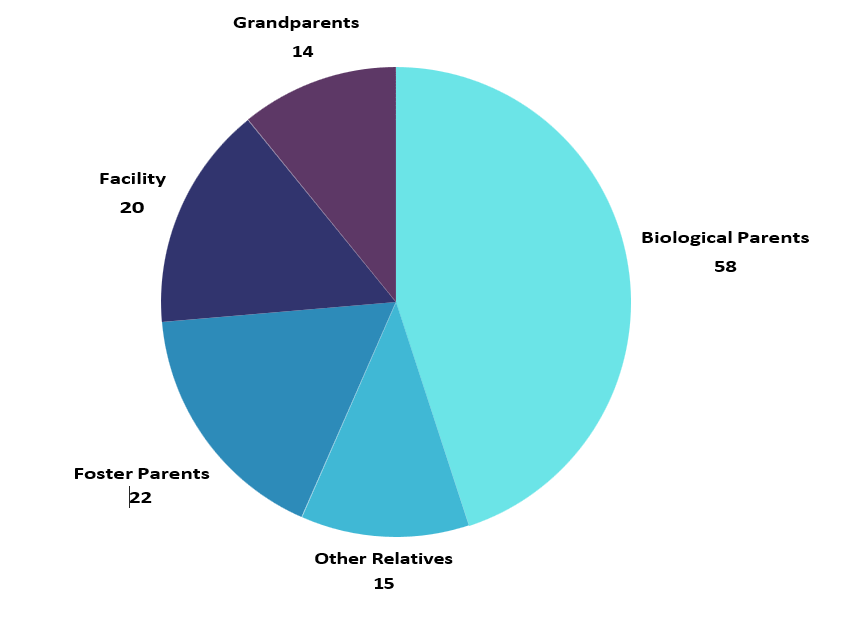
Other Relatives include grandparents, other blood relatives, and fictive kin
Other referrals or requests for help came from:
- School Nurses or Counselors
- Therapists
- Children/Juveniles
- ACCARDV Commissioners
- Other Child Welfare Stakeholders
Type of Requests for Assistance or Complaints
- DCFS Policy/Conduct: allegations that policy was not followed by DCFS employee, or conduct by DCFS employee was called into question
- Judicial Action: complaint regarding actions taken by a judge affecting a child welfare case
- Hotline Issues: maltreatment investigation questions, concerns, and allegations related to response from the Arkansas State Police Child Abuse Hotline
- Statute-related Issue: questions or concerns about a particular statute related to child welfare and its application; issues that can be resolved by referring someone to a statute
- Foster Child Placement: issue in regard to the placement of child currently in foster care
- Abuse Concerns: allegation that abuse is not being addressed through a maltreatment investigation or an open dependency-neglect case; may also be tied to concerns about the Child Abuse Hotline
- Disrupted Adoption: complaint that an adoption has been disrupted and services are needed by DHS and being denied; complaint that services are needed to prevent disruption and referrals are needed
- Grandparent or Fictive Kin Custody/Placement: complaint that family or fictive kin are being overlooked for placement in a dependent-neglect case
- Aftercare Issues: concerns over cases involving children that have chosen to stay in DCFS care after they reach the age of majority
- Juvenile Justice: issues within the juvenile delinquency system where youth are placed in Juvenile Detention Centers or have been charged with a crime and have experienced abuse or neglect or are foster youth in this system
Requests for Assistance by County
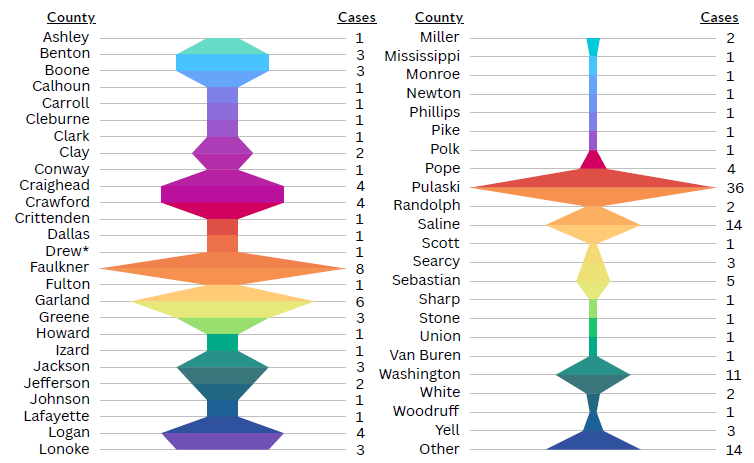
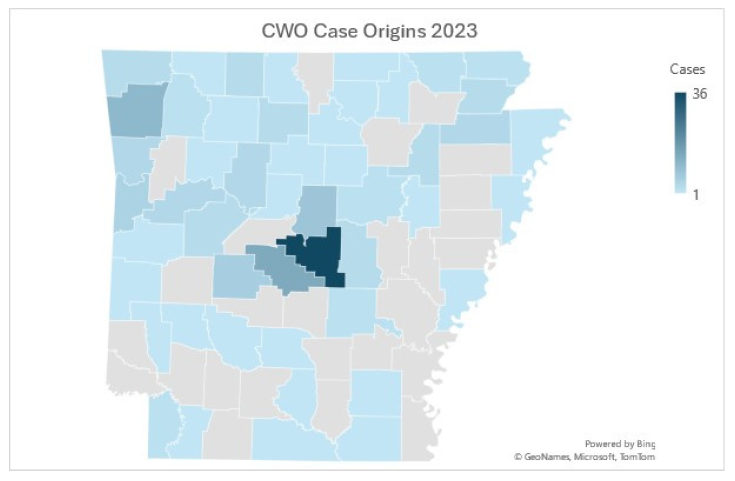
Inquiries were received from 40 Counties listed below. One complaint was received from Texas, but as a domestic relations custody case, it was outside of the legislative purview of the CWO. Two in-state domestic relations cases were received but were referred to their attorneys for further assistance.
Missouri 1 * Oklahoma 1 * Mississippi 1 * United Kingdom 1
*Drew County – this report affected six separate juveniles with DN cases across the state
*Other – county data was not collected for some requests that were outside the purview of the Ombudsman program or for referrals
Trends in Cases Investigated
As the program has grown, trends have been noted and directly addressed with agencies involved. Some issues may need to be addressed legislatively to be resolved appropriately. Ideally, as the CWO brings challenges within the system to the attention of stakeholders, barriers will be viewed through a lens or working collaboratively to improve the child welfare system to keep children safe and families intact when possible, while supporting foster and adoptive families, as well as the professionals in the field. The CWO notes the following trends and examples with the sincere desire to work collaboratively to resolve issues and support families and staff. Some trends are more prevalent in specific reporting years, while other trends may be cumulative from previous years, but highlighted in a particular CWO report.
Lack of Documentation
One trend pertained to DCFS investigations and lack of documentation. For example, in environmental neglect investigations there may be a lack of documentation regarding areas of concern and a general statement is made such as “the home is cluttered.” Pictures to document these cases are usually not taken, or there is no reference to pictures being taken if that was done, so it is unknown upon review of the investigative documentation. Supervisors reviewing these investigations approved and closed them with incomplete information provided. DCFS policy requires such documentation as well as supervisors to review and approve investigations, including the documentation, before closing.
Lack of Follow-Up on New Disclosures
It was also discovered that when other types of abuse are disclosed during an investigation or open Protective Services (PS) case, there is very little exploration of those disclosures, the new allegation is not added to an existing report, and/or no new report is made to the hotline despite DCFS employees being mandated reporters. This issue was noted and explored with DCFS in several cases. The CWO made several reports to the hotline due to additional allegations never being added to open investigations or open PS cases when allegations were made or became apparent. Examples of allegations made or maltreatment occurring during investigations or open PS cases include, but are not limited to; children testing positive on hair shaft drug screens for cocaine, THC, methamphetamines, and fentanyl; educational neglect; substance misuse (giving kids alcohol); physical abuse and medical neglect.
“ Examples of allegations made or maltreatment occurring during investigations or open PS cases include, but are not limited to; children testing positive on hair shaft drug screens for cocaine, THC, methamphetamines, and fentanyl; educational neglect; substance misuse (giving kids alcohol); physical abuse and medical neglect. ”
Concerns Regarding the Investigation of Medical Neglect Allegations
Another trend regarding investigations for both DCFS and CACD related to investigating medical neglect. In cases the CWO investigated this year, physicians who made diagnoses or recommended treatment for certain conditions were not interviewed. Investigative determinations were made by interviewing current physicians who were not treating the children for the conditions in question and were not properly questioned about the conditions and coordination or receipt of medical records (or lack thereof) from the previous treating physicians. For example, one child was placed on a medication to aid in weight gain for failure to thrive. The child was taken off of the medication by the caregiver, and the child’s doctor was changed. The original prescribing physician was not interviewed, and the new doctor was not interviewed about the medication and whether or not they knew about the prescribed medication and had determined the child no longer needed the medication. The child lost weight while with this caregiver and was not treated for the failure to thrive condition.
Relatives Not Being Properly Considered for Placement
There was another significant trend regarding relatives not properly being considered for placement, especially out of state relatives. In several cases, referrals were not made to ICPC (Interstate Compact for the Placement of Children) or to DCFS resource workers if in-state, until the CWO was contacted and made an inquiry to DCFS. In many of these instances, the relative or fictive kin was deemed appropriate by the authorizing agency after the homes and backgrounds were reviewed. In one case, relatives were approved by the state they resided in through ICPC. However, there was no mention of these relatives in any Arkansas DCFS records or court records. The children were adopted by foster parents in Arkansas where they were abused and placed back in foster care.
County with Over-Representation
Geographically, Logan County was a focus for the CWO who received complaints regarding both investigations and case work services. There were four cases in this county. Complaints included worker bias against parents, changes in procedures and rules for parents during cases that differ from rules that were already in place and explained, missed visitations by DCFS between parents and their children, lack of communication among DCFS workers impacting services, unprofessional conduct, lack of documentation in case work services and investigations. This investigation continued into 2024 with additional cases when changes were implemented and will be explored further in that report. DCFS Central Office and the Area Director’s Office were receptive to responding to concerns raised by the CWO.
Placement Issues with Older Foster Children
As mentioned in the 2021-22 report, placement issues were prevalent regarding DCFS foster children who were older, post-TPR, and had multiple issues that need to be addressed, either behaviorally or psychologically. They are often moved from one behavioral treatment facility to another repeatedly. This problem is situated within the mental and behavioral health systems, but affects families both in the child welfare and other juvenile systems. This report will address Juvenile Justice and placement issues below.
Juvenile Justice
Beginning in 2022 and throughout 2023, several Juvenile Justice issues were brought to light involving child maltreatment for youth detained in juvenile detention centers (JDC) or who were the subject of delinquency cases. The CWO was able to at least partially investigate issues due to the youth being a foster youth or allegations of maltreatment occurring in a JDC. Several of these investigations involved co-investigations with the DYS Ombudsman as some of the youths were DYS detainees residing at local JDC facilities.
Complaints involving Juvenile Justice issues:
- Juveniles being improperly convicted of actions that were not crimes
- Juveniles improperly detained beyond statutory timeframes and never adjudicated as delinquent
- Educational neglect
- Improper use of solitary confinement, restraints, tasers, and pepper spray
- Physical abuse
- Sexual abuse
- Failure of mandated reporters within JDCs to report abuse and neglect including JDC staff, educators working within the JDC, and medical personnel
Regarding the first bullet point: these were six (6) foster youth placed in a QRTP foster care placement. The Juvenile Probation Office conducted drug screens for youth who were not on probation or otherwise under the charge of this judicial district’s juvenile office. This was at the request of QRTP staff. The youth were charged under Arkansas Code Annotated § 5-64-419 for possession of a controlled substance which requires that drugs be present and quantified. No juveniles had any drugs in their possession, and one juvenile refused the drug screen. Under no circumstance is this behavior a criminal offense. Thankfully, a DCFS caseworker recognized that these charges were concerning and reported the information to one of the juveniles’ attorney ad litem (AAL), who further investigated and involved the CWO. The CWO enlisted the assistance of DCFS, Office of the Chief Counsel (OCC), Prosecutor Coordinator’s Office (PCO) the Prosecuting Attorney for the judicial District, and the Public Defender Commission, who all cooperated to rectify the problem.
Bullet points two through six are related to juveniles placed in JDCs. Additionally, there were significant issues of abuse in 2 JDCs, and there were failures in both facilities to report abuse to the hotline despite staff being mandated reporters. These facilities are not in compliance with detention standards as set forth in Arkansas Juvenile Detention Standards 2014[RLA1]. The Criminal Detention Facilities Review office was made aware of these allegations and investigations, however the allegations were not apparently under this agency’s authority.
Each JDC is independently operated by a county’s local government or sheriff’s department. There is no central oversight for these facilities and their compliance with federal detention standards, the constitutional rights of juveniles in regard to required educational and therapeutic programming, or the following of state laws regarding juveniles and their legal status as a detainee. The standards for juvenile facilities are written in such a way that the JDC only has to provide proof of a written policy, not proof that they abide by that policy. There are also no penalties for not being out of compliance with state detention standards. A county has not incentive to improve the conditions of their JDC under current standards.
Success Stories
Positive outcomes for children and families over the past year include: children leaving foster care to be placed with relatives or fictive kin upon proper assessment by Arkansas DCFS or through an assessment by ICPC; parents had true findings overturned; children who had been removed from their parents were returned home, and court cases were dismissed prior to Adjudication hearings. All of these outcomes happened because of the involvement of the CWO. Many of those served by the CWO offered their praise and positive experience with our office:
“The Child Welfare Ombudsman helped me in so many different ways by providing me not only with knowledge but hope and support every step of the way. My girls and I were constantly deceived and mistreated by DHS. The Ombudsman was there to provide constant support to help me navigate the wrongdoings of DHS. She came with us to nearly every court date and gave us understanding of what happened in court. She was always just a phone call away if I had questions or concerns. She was the guiding light at the end of a very dark tunnel. If not for her, I am not sure I would have my girls now. I will never have enough words to show my appreciation and gratitude.” -a fictive-kin that was assisted by the CWO throughout the dependency-neglect case
“The Ombudsman Program provided the guidance and advocacy I needed to secure my adoption. They are a valued entity with a wealth of knowledge and resources. I truly value and appreciate their service. Ms. Stasia McDonald is very attentive, knowledgeable, professional, and compassionate!”-a foster parent
“The Ombudsman program has been an invaluable resource, providing support throughout the challenges we’ve faced. They’ve shown an understanding of our concerns, offering assistance that’s helped us navigate complex situations with greater clarity. The program’s commitment to investigating concerns and ensuring information is passed on to the appropriate team has not only improved our situation, but has also potentially shed light on areas of concern within the system. We are incredibly grateful for the program’s support.” -a guardian who had children placed in her care due to the parent’s neglect and there were issues with a lack of safety measures by DCFS in the case when sexual abuse was investigated and found true
“I began communicating with the Ombudsman, and she was a God-send. She gave me pertinent information and she was there just when I needed to talk. It was a very difficult time. My grandchild is back with her mother, and the Ombudsman still keeps in contact with me just to see how everything is going. I am thankful and grateful for all her help.” -a grandparent who sought assistance due to DCFS not ensuring contact and visitation with her grandchild while she was in foster care
“The Ombudsman program has repeatedly demonstrated unwavering commitment to ensuring that families dealing with the foster care system receive appropriate assistance. One case in particular stands out as a testament to their skill, persistence and dedication. When constant roadblocks were put up to halt timely reunification of a family, the Ombudsman program was instrumental in what was a long overdue reunification between a biological father and his children.”-Attorney ad litem
“Having the Child Welfare Ombudsman Office has led to better outcomes for families who are faced with difficult situations. The Office brings to cases a focus on best outcomes that is less positional and more best practice, which often gets lost in the shuffle of day-to-day case work. The Office has been and is an invaluable asset for all parties involved.”-Parent Counsel
Barriers to Investigation
Information Access
The largest barrier to investigations was not being able to access court cases through the statewide system, CourtConnect. The Ombudsman may not initially know who the attorneys are without the ability to research a case in CourtConnect. The Ombudsman would have to contact DHS Office of Chief Counsel (OCC) to discover this information then rely on attorneys connected to the case to provide court documents and case information that is easily accessible through CourtConnect. The Ombudsman Office would often not have access to upcoming court dates and other pertinent information. The Ombudsman Office is forced to wait to rely on other very busy attorneys to provide requested information that is easily obtainable through CourtConnect access. Having to request this information through other involved parties to a case also undermines the autonomy and independence of the Ombudsman Office. The Ombudsman legislation gives the Ombudsman the authority to access necessary case information, but CourtConnect access has not been granted by the Administrative Office of the Courts. Based on inquiries within The USOA network, other states have access to their state’s central court online record system.
Recommendations
Legislative Recommendations
- Access to CourtConnect and in-house DCFS database (currently CHRIS) should be statutorily mandated (See previous section). Colorado allows the Child Protection Ombudsman the authority to request and review any information, records, or documents that ombudsman deems necessary to conduct a thorough and independent review. See C.R.S. 19-3.3-103. Statutory access would allow for consistent access, rules to be in place to address the confidential nature of the information and allow for efficiency in the investigation and review process. Michigan, Washington state, and Georgia allow access to their internal case management system via statute. This protects the independence of the Ombudsman during their investigations and prevents any appearance of impropriety when being able to obtain access to information necessary for a thorough review of a complaint.
- Add a Juvnile Justice Ombudsman to oversee issues y outh experience while going through the juvenile justice system.
- Mandate that children in foster care be provided with access to contact information to the Child Welfare Ombudsman. Contact information could be provided to foster children through their attorneys, foster parents, or placements. In Texas, it is required that all residential treatment placements have the Ombudsman’s contact information posted in an area easily accessible by the child.
- Mandate that offenders who are the subject of an investigation as well as parents whose children are removed from their custody be provided with access to contact information to the Child Welfare Ombudsman. Contact information could be provided on investigative materials provided to alleged offenders and could be provided in documents provided to parents upon removal of children. This could be in the form of language in maltreatment publications (pubs) or a separate document containing CWO contact information.
General Recommendations
It is recommended that more training and supervision for DCFS employees be provided regarding documentation of investigations. Specific concerns were addressed during this reporting period that were related to investigations, especially capturing and documenting additional sources of evidence such as photographs and reports by third parties (law enforcement, medical providers, schools).
It is recommended that information regarding interested relatives or fictive kin be documented, both in CHRIS and in court orders, including the names of the relatives or fictive kin, their relationship to the children, whether or not placement is appropriate, and the reasoning for the placement recommendation. In most of the cases CWO investigated, there was no mention of such relatives or fictive kin in CHRIS, the case plans, court reports, or the court orders. Thus there was often no proof that the necessary steps were taken by DCFS to assure that the relatives or fictive kin were given the opportunity to be a placement for the children as required by Arkansas Code §9-28-108 which defines fictive kin and outlines the relative and fictive kin placement priority for children in foster care. Arkansas Code §9-27-355 mandates that relatives and fictive kin shall be considered for placement of foster children and as permanent guardians or adoptive parents for children and are given priority for such placements. DCFS policy VI-B complies with the Arkansas Juvenile Code and defines relatives and fictive kin and procedures for placement of children. It does specify that relatives and fictive kin are to be given preferential consideration for placement of children. The aforementioned recommendation would assure that the statute and DCFS policy are in fact being followed by DCFS staff regarding relative and fictive placements.
It is recommended that investigators receive additional training regarding obtaining and documenting evidence and exploring other forms of abuse and neglect. Supervisors should review disclosures to ensure that additional abuse and neglect allegations are added to reports and investigated prior to approving and closing the investigation.
“Having the Child Welfare Ombudsman Office has led to better outcomes for families who are faced with difficult situations. The Office brings to cases a focus on best outcomes that is less positional and more best practice, which often gets lost in the shuffle of day-to-day case work. The Office has been and is an invaluable asset for all parties involved.”
Summary
As the Ombudsman Division grows and handles more cases, we will need to collaborate with all stakeholders to address the issues and challenges that face the child welfare system. As we are able to document trends and challenges, we will be better situated to make recommendations to stakeholders on improvements to the system at the county and state level. Arkansas is a very diverse state and the challenges and issues that are faced by its families cannot always be handled with cookie cutter solutions. It will require commitment and collaboration from all stakeholders to provide solutions that will work for all Arkansans.
Several groups continue to predominately seek the assistance of the CWO. These groups are parents, relatives (and fictive kin), and foster parents. The CWO strives to educate these groups regarding the laws and policies pertaining to their specific situation as well as their rights in general. Educating and reaching
additional groups within the child welfare system, such as youth and mandated reporters, remains a priority for the Ombudsman program. Tracking or verifying the implementation of CWO recommendations is a future goal once a database or case management system has been obtained.
The Child Welfare Ombudsman Division of the Arkansas Commission on Child Abuse, Rape, and Domestic Violence exists as an independent voice within the child welfare field in Arkansas. As we enter our fourth year of service to the people of Arkansas, we will continue to serve the families involved in the child welfare system in Arkansas that request our assistance.
Glossary of Acronyms
ACCARDV – Arkansas Commission on Child Abuse, Rape, and Domestic Violence
ARBEST – Arkansas Building Effective Services for Trauma
CASA – Court Appointed Special Advocates
CJA – Children’s Justice Act
CWO – Child Welfare Ombudsman
DCFS – Division of Children and Family Services
DHS – Department of Human Services
DN – Dependency-Neglect
JDC – Juvenile Detention Center
MDT – Multi-Disciplinary Team
QRTP – Qualified Residential Treatment Program
USOA – United States Ombudsman Association
Appendix
Enabling Legislation: A.C.A. § 20-82-211